At this point, everyone who plays games knows that Portal 2 is one of the best games of the year and most people who are interested in it have already played it, but I do feel it's worthwhile to say a few non-spoiler things about it.
First and foremost, if you are at all interested in the game, go and play it right now. Don't put it off any longer. As with the original, the surprises are some of the best parts of Portal 2 and the longer you go without playing it, the greater the chance that you'll have them ruined for you accidentally or intentionally.
While the potential for replay is about the same as it was in the first game, you'll definitely want to play Portal 2 on your system of choice as you only get to experience it for the first time once. For me, that was the Windows version, which looks downright awesome with all the video settings maxed.
Play through the single player experience before playing the co-op. The reasons for this will become obvious once you do.
When a bit more time has passed, I plan to write a more detailed piece on this game, but it's impossible to do that without spoiling at least some aspects of the experience. Bottom line: If you think you might want to play this game, go play it. It's great. If you haven't played the original Portal yet, it's not required to appreciate and enjoy Portal 2, but you should play it as well given the opportunity. It's also great. :)
Tuesday, May 17, 2011

Saturday, May 14, 2011
Brink Patched
Just a quick note. Splash Damage has released a patch for Brink via Steam that addresses a lot of the issues people have been having with the Windows version of the game. I gave it a try last night and it has indeed made substantial improvements. There still seem to be a few little quirks and bugs for them to iron out; especially with regard to sound, but there's now no doubt that they're taking customer feedback about the game into consideration and acting on it in a timely manner. I'm now even more confident endorsing this game and encourage anyone who's interested in it to give it a try.
I should also mention that Splash Damage has announced that the first DLC for Brink, which is scheduled to be released in June, will be free as a "thank you" to everyone for buying the game and putting up with the initial technical problems. Perhaps that's just PR spin on their part, but free "maps and additional content" sounds good to me in any case. :)
I should also mention that Splash Damage has announced that the first DLC for Brink, which is scheduled to be released in June, will be free as a "thank you" to everyone for buying the game and putting up with the initial technical problems. Perhaps that's just PR spin on their part, but free "maps and additional content" sounds good to me in any case. :)
Friday, May 13, 2011
A Little Love for Brink
Note: For some unexplained reason, my original version of this post disappeared. I'm going to re-post it with a few updates based on new information that's been made available since yesterday and some additional experiences I've had with the game since then, but if problems persist, I may need to look into moving this blog and its content elsewhere.
I'm often dismayed when I read game reviews these days. More and more, I feel like I just can't relate to the mindset of the average game reviewer. It probably has a lot to do with the shift away from objective analysis of a game's technical execution and toward more subjective areas. As someone who's made a decent living over the years as a programmer, I still tend to look at games as technical achievements, and while I certainly have likes and dislikes when it comes to narrative themes, settings, artistic styles and all manner of subjective qualities that comprise the total package of a game, I'm always extremely hesitant to shit all over something that people have clearly spent a lot of time and effort crafting. A game has to be genuinely horrible in some measurable way for me to hate on it and despite what a lot of people on the internet seem to think, Brink is nowhere near a bad game.

Does it have issues? Absolutely it does, and I'll touch on those a bit later, but I think this game is getting a very unfair treatment from many in the critical community and I'd like to do my part to help offset that a bit. As I write this, there are over 15 thousand people playing it on Steam who certainly wouldn't be if it were half as bad as some folks are making it out to be. I've personally logged about 20 hours with the game and have completed all the campaign and "What if..." missions both from the perspective of the Security Forces and the Guests, which has left me with a level 18 (Rank 4) character and a level 4 (Rank 1) alt that I've been experimenting with.
So, for those unaware, Brink is a Team/Objective-Centric First-Person Shooter from the developer Splash Damage, which started out as a modding group that created the famous Enemy Territory mod for the classic FPS Return to Castle Wolfenstein back in the day. They've since applied the Enemy Territory style of gameplay to the Quake IP with Enemy Territory: Quake Wars, but Brink is the first game they've built from the ground up (IP and all).

In a lot of ways, Brink is a very ambitious game. It combines elements seen in other popular FPSes from recent years in a way that is kinda mind-boggling when you stop and think about it.
Character movement through the environments feels like a streamlined version of the traversal mechanics from Mirror's Edge, with the additional wrinkle of three potential body types that effect how nimble or durable your character is.
Weapons feel a lot like Borderlands, but instead of picking up a new one every five minutes, you'll be unlocking augmentations like scopes, red dots, extended magazines and stabilizers that can be added to a selection of primary and secondary weapons that broadens as you move toward the heavy body type, which is required to wield the more hefty armaments. Some folks have been complaining about the sound of the weapons. I say, get better speakers. There's a ton of dynamic range and subtlety in how each gun sounds but you're not going to notice it on $30 speakers or a $10 pair of headphones. So many shooters have ear-crushingly, overblown sound that lacks any sort of finesse or basis in reality that I actually find the sound design of the weapons in Brink quite refreshing. In all seriousness, if you think all the guns in Brink sound the same, you may want to have your ears checked because you've probably lost or are in the process of losing some of your hearing.

General gameplay feels very Battlefield-esque. The team/class/objective-based nature of it can't help but evoke the feel of that series. There are a decent variety of objective types, but you'll definitely find yourself doing the same sorts of things pretty frequently if you stick to primary objectives. That's certainly a valid approach, but it should be said that there are a lot of great tactical opportunities and advantages provided by pursuing and completing many of the secondary objectives on a given map. Controling additional Command Posts or opening and closing additional routes through the level can be real difference makers, especially when the teams are evenly matched in terms of skill.
Speaking of skill, I've seen some reviewers complaining about bots in the game being ineffective. Granted, they aren't the sharpest tools in the shed, but I've seen way worse and they do scale pretty well at different difficulty levels and as missions progress and time starts to get short. Sure, the AI could use some tweaking and improvement, but with the greater-then average sophistication present in the game's mechanics and traversal system, I think people are being a bit harsh in their judgement of the bot AI.

I hate to keep making all these comparisons to other games but in a lot of ways Brink feels like a combination of a lot of the best elements from some of the best FPSes in recent memory, and for the most part, it does exactly what it set out to do; however, as I said before, there are some problems with it.
For me, the bottom line is that I really like this game. Despite its issues, which I have confidence will be resolved in time, I've been having an absolute blast playing it and it's been providing me with exactly what I wanted from it. Could it be better? Sure, but it could also be a LOT worse.
I'm often dismayed when I read game reviews these days. More and more, I feel like I just can't relate to the mindset of the average game reviewer. It probably has a lot to do with the shift away from objective analysis of a game's technical execution and toward more subjective areas. As someone who's made a decent living over the years as a programmer, I still tend to look at games as technical achievements, and while I certainly have likes and dislikes when it comes to narrative themes, settings, artistic styles and all manner of subjective qualities that comprise the total package of a game, I'm always extremely hesitant to shit all over something that people have clearly spent a lot of time and effort crafting. A game has to be genuinely horrible in some measurable way for me to hate on it and despite what a lot of people on the internet seem to think, Brink is nowhere near a bad game.

Does it have issues? Absolutely it does, and I'll touch on those a bit later, but I think this game is getting a very unfair treatment from many in the critical community and I'd like to do my part to help offset that a bit. As I write this, there are over 15 thousand people playing it on Steam who certainly wouldn't be if it were half as bad as some folks are making it out to be. I've personally logged about 20 hours with the game and have completed all the campaign and "What if..." missions both from the perspective of the Security Forces and the Guests, which has left me with a level 18 (Rank 4) character and a level 4 (Rank 1) alt that I've been experimenting with.
So, for those unaware, Brink is a Team/Objective-Centric First-Person Shooter from the developer Splash Damage, which started out as a modding group that created the famous Enemy Territory mod for the classic FPS Return to Castle Wolfenstein back in the day. They've since applied the Enemy Territory style of gameplay to the Quake IP with Enemy Territory: Quake Wars, but Brink is the first game they've built from the ground up (IP and all).

In a lot of ways, Brink is a very ambitious game. It combines elements seen in other popular FPSes from recent years in a way that is kinda mind-boggling when you stop and think about it.
Character movement through the environments feels like a streamlined version of the traversal mechanics from Mirror's Edge, with the additional wrinkle of three potential body types that effect how nimble or durable your character is.
Weapons feel a lot like Borderlands, but instead of picking up a new one every five minutes, you'll be unlocking augmentations like scopes, red dots, extended magazines and stabilizers that can be added to a selection of primary and secondary weapons that broadens as you move toward the heavy body type, which is required to wield the more hefty armaments. Some folks have been complaining about the sound of the weapons. I say, get better speakers. There's a ton of dynamic range and subtlety in how each gun sounds but you're not going to notice it on $30 speakers or a $10 pair of headphones. So many shooters have ear-crushingly, overblown sound that lacks any sort of finesse or basis in reality that I actually find the sound design of the weapons in Brink quite refreshing. In all seriousness, if you think all the guns in Brink sound the same, you may want to have your ears checked because you've probably lost or are in the process of losing some of your hearing.

General gameplay feels very Battlefield-esque. The team/class/objective-based nature of it can't help but evoke the feel of that series. There are a decent variety of objective types, but you'll definitely find yourself doing the same sorts of things pretty frequently if you stick to primary objectives. That's certainly a valid approach, but it should be said that there are a lot of great tactical opportunities and advantages provided by pursuing and completing many of the secondary objectives on a given map. Controling additional Command Posts or opening and closing additional routes through the level can be real difference makers, especially when the teams are evenly matched in terms of skill.
Speaking of skill, I've seen some reviewers complaining about bots in the game being ineffective. Granted, they aren't the sharpest tools in the shed, but I've seen way worse and they do scale pretty well at different difficulty levels and as missions progress and time starts to get short. Sure, the AI could use some tweaking and improvement, but with the greater-then average sophistication present in the game's mechanics and traversal system, I think people are being a bit harsh in their judgement of the bot AI.

I hate to keep making all these comparisons to other games but in a lot of ways Brink feels like a combination of a lot of the best elements from some of the best FPSes in recent memory, and for the most part, it does exactly what it set out to do; however, as I said before, there are some problems with it.
- Matchmaking could be better. It's a little old school, at least on the Windows version. There's some minimal support for Steam friends, but it takes a bit more effort to figure out how to get a game running with friends than I'd prefer and there are some oddities like the host having to be the highest ranked player if there's a discrepancy and the need to open TCP/UDP ports 27015 and 27016 if you are hosting a game. Nothing really new for most PC gamers, but I find myself wishing the whole thing was a bit more elegant and simplified.
- Multiplayer performance, at least on the PC, seems a bit sketchy when you get more than six or so people in the game. Playing with a couple friends consistently worked without a hitch, but results have been more mixed in games with more human players involved.
- There's a nasty rendering glitch, again on the PC, for many users of AMD Radeon GPUs wherein whitish grid lines appear over everything that's being rendered at times. Some folks have also reported drastic framerate drops at times on said GPUs but that seems to be a less common issue as I haven't experienced it since upgrading to the latest Catalyst hot fix (11.5a).
- The good news for console owners, is that these problems don't seem to exist there. Of course, with the PSN still down as of this writing, PS3 users won't be able to put that theory to the test, but 360 users seem to be fairing okay aside from some reports of multiplayer lag that have cropped up since the initial patch for that version of the game.
- The narrative elements of the game are a bit thin. They basically consist of a few cut scenes that bookend each of the eight campaign missions and some audio logs that get unlocked as you level up your character. I didn't buy this game on the promise of narrative or single-player set pieces, so this isn't a big letdown for me, but I do think it's fair to say that people looking for those things will be disappointed with what Brink has to offer in that regard. A contemporary in terms of narrative bulk and presentation would be Left 4 Dead, where the narrative elements and setting are more of an accent or an excuse for the carnage than a end unto themselves.
- There's already been a patch for the Windows version of the game to address a potential game save-killing bug, but Splash Damage still has some work to do to address the aforementioned technical problems and some others that I haven't personally been able to duplicate.

For me, the bottom line is that I really like this game. Despite its issues, which I have confidence will be resolved in time, I've been having an absolute blast playing it and it's been providing me with exactly what I wanted from it. Could it be better? Sure, but it could also be a LOT worse.
Monday, April 25, 2011
Staying Power
Games come and go. Each and every week there's something new and exciting to tempt the attention span of anyone who makes a habit of playing them, and more often than not, new games do just that. They pull us away from whatever we had been playing with the promise of shiny, new graphics, gameplay, or stories and characters.
Of course, there are the exceptions; games that are so good, so well crafted and so deep and re-playable that they pull us back despite such distractions.
Here are a few of my current favorites:
Battlefield: Bad Company 2 (Windows/360/PS3)
As far as I'm concerned, this game is THE reason to own a hot gaming PC. Sure, you can play it on an XBOX 360 or PS3, but the look and feel of it on a nicely-equipped PC is a big part of what gaming is all about for me. Needless to say, I'm extremely excited for Battlefield 3 this fall.

Need for Speed: Hot Pursuit (Windows/360/PS3)
The best racing game since Burnout Paradise; unsurprisingly crafted by the same developer. The cat and mouse nature of the "Hot Pursuit" mode is a phenomenal gameplay experience that transcends the racing game genre; giving you more to do in the game than simply drive from point A to point B as fast as possible for those unsatisfied with simply racing. Again, play this on a hot gaming PC if you can.

Gran Turismo 5 (PS3)
I know. I know. Forza 3 for the XBOX 360 is a better game from a structural standpoint. But there is something about GT5. It may not have been the end all, be all racing game that everyone was expecting it to be, but it does have merits and the sheer level of car porn in it is unrivaled. The steady stream of patches since its release don't hurt and there's no denying the passion and sincerity of it. Call it a guilty pleasure if you want, but I like this game and often find myself returning to it above all others when I'm looking for a simulation racing fix.

Civilization V (Windows/Mac)
Even though the newness of it has worn off and a few design flaws have yet to be corrected in it, there's no doubt that Civ remains the king of the turn-based strategy genre. When I feel that particular itch, I need go no further for relief. Are there problems with it? Indeed there are, but the simple fact is it does more right than it does wrong and there are few if any games out there that can rival its ability to make doing the same thing over and over feel fresh and exciting with each new game.

World of Warcraft (Windows/Mac)
What list of addictive, recurring games would be complete without this one? I have no doubt sunk more time into this game than any other. Whether it's soloing an alt, or raiding with a guild or grouping with friends for a 5-man or some PvP, WoW still offers the best combination of the RPG and social gaming genres. If you're into swords and sorcery, and you want an RPG you can play alone or with friends, for better or worse, there's precious little out there that can hold a candle to it.

Modern Combat: Domination (PS3)
Go ahead and mock me all you want. This PS3 downloadable game is fun and easy to pick up, play, make some measurable progress, and put back down on a whim. It surely doesn't have all the bells and whistles of better shooters like Battlefield, but for a cheap and easy thrill, it's hard to beat.

Left 4 Dead 2 (Windows/Mac)
When you want to shoot things in the face and you don't want to have to worry about levels or kits or perks or any of that nonsense, Left 4 Dead 2 is your game. Sure, zombies are a little played out, but the zombie-apocalypse theme is almost inconsequential to the gameplay. The zombies might as well be Teletubbies. In fact, there's a mod for that. :)

Borderlands (Windows/Mac)
This game is on the list for one simple reason: Co-op. With support for up to four-player co-op throughout the entire single-player campaign plus extensive DLC packs and support for multiple playthroughs, there are literally hundreds of hours of satisfying FPS/RPG gameplay to be had here. True, there's room for improvement, but that's what sequels are for. Borderlands 2? Hell yes, please! :)

Worms (Windows/360/PS3/iOS)
Worms: Reloaded for Windows is the current incarnation I'm playing, but I've been playing and enjoying this delightfully-twisted take on the classic, turn-based "artillery" game genre for years on a variety of platforms. In fact, I probably own more versions of this game on more different systems than any other.

Are there other games I love as much or more than these? Sure there are. There are fantastic games that I spent five or 10 or 15 hours playing through and "finished," or that I enjoyed for a good, long while then got burnt out on and haven't returned to recently. This isn't meant to be a definitive list; just a few recommendations for games that I've personally spent a lot of time and had a lot of fun with and have periodically felt compelled to revisit over the past several months.
Of course, there are the exceptions; games that are so good, so well crafted and so deep and re-playable that they pull us back despite such distractions.
Here are a few of my current favorites:
Battlefield: Bad Company 2 (Windows/360/PS3)
As far as I'm concerned, this game is THE reason to own a hot gaming PC. Sure, you can play it on an XBOX 360 or PS3, but the look and feel of it on a nicely-equipped PC is a big part of what gaming is all about for me. Needless to say, I'm extremely excited for Battlefield 3 this fall.

Need for Speed: Hot Pursuit (Windows/360/PS3)
The best racing game since Burnout Paradise; unsurprisingly crafted by the same developer. The cat and mouse nature of the "Hot Pursuit" mode is a phenomenal gameplay experience that transcends the racing game genre; giving you more to do in the game than simply drive from point A to point B as fast as possible for those unsatisfied with simply racing. Again, play this on a hot gaming PC if you can.

Gran Turismo 5 (PS3)
I know. I know. Forza 3 for the XBOX 360 is a better game from a structural standpoint. But there is something about GT5. It may not have been the end all, be all racing game that everyone was expecting it to be, but it does have merits and the sheer level of car porn in it is unrivaled. The steady stream of patches since its release don't hurt and there's no denying the passion and sincerity of it. Call it a guilty pleasure if you want, but I like this game and often find myself returning to it above all others when I'm looking for a simulation racing fix.

Civilization V (Windows/Mac)
Even though the newness of it has worn off and a few design flaws have yet to be corrected in it, there's no doubt that Civ remains the king of the turn-based strategy genre. When I feel that particular itch, I need go no further for relief. Are there problems with it? Indeed there are, but the simple fact is it does more right than it does wrong and there are few if any games out there that can rival its ability to make doing the same thing over and over feel fresh and exciting with each new game.

World of Warcraft (Windows/Mac)
What list of addictive, recurring games would be complete without this one? I have no doubt sunk more time into this game than any other. Whether it's soloing an alt, or raiding with a guild or grouping with friends for a 5-man or some PvP, WoW still offers the best combination of the RPG and social gaming genres. If you're into swords and sorcery, and you want an RPG you can play alone or with friends, for better or worse, there's precious little out there that can hold a candle to it.

Modern Combat: Domination (PS3)
Go ahead and mock me all you want. This PS3 downloadable game is fun and easy to pick up, play, make some measurable progress, and put back down on a whim. It surely doesn't have all the bells and whistles of better shooters like Battlefield, but for a cheap and easy thrill, it's hard to beat.

Left 4 Dead 2 (Windows/Mac)
When you want to shoot things in the face and you don't want to have to worry about levels or kits or perks or any of that nonsense, Left 4 Dead 2 is your game. Sure, zombies are a little played out, but the zombie-apocalypse theme is almost inconsequential to the gameplay. The zombies might as well be Teletubbies. In fact, there's a mod for that. :)

Borderlands (Windows/Mac)
This game is on the list for one simple reason: Co-op. With support for up to four-player co-op throughout the entire single-player campaign plus extensive DLC packs and support for multiple playthroughs, there are literally hundreds of hours of satisfying FPS/RPG gameplay to be had here. True, there's room for improvement, but that's what sequels are for. Borderlands 2? Hell yes, please! :)

Worms (Windows/360/PS3/iOS)
Worms: Reloaded for Windows is the current incarnation I'm playing, but I've been playing and enjoying this delightfully-twisted take on the classic, turn-based "artillery" game genre for years on a variety of platforms. In fact, I probably own more versions of this game on more different systems than any other.

Are there other games I love as much or more than these? Sure there are. There are fantastic games that I spent five or 10 or 15 hours playing through and "finished," or that I enjoyed for a good, long while then got burnt out on and haven't returned to recently. This isn't meant to be a definitive list; just a few recommendations for games that I've personally spent a lot of time and had a lot of fun with and have periodically felt compelled to revisit over the past several months.
Tuesday, April 19, 2011
PS3 SSD
As someone who's built more than a few PCs from parts, I occasionally get the itch to tinker with things; sometimes even when they're not meant to be tinkered with, but that's another story.
This time, I decided to focus my attention on my PS3 and the often-painfully-slow 5400 RPM hard drive that the system ships with.
True, for the most part, the default PS3 hard drive gets the job done, but as someone who plays a lot of downloaded Playstation Network games and Blu-Ray-based games like "Gran Turismo 5" that require massive hard drive installs and usage, I felt like it was time to give the system a little more oomph.
In and of itself, replacing the hard drive in a PS3 is a pretty simple and well-documented process, involving just a few tools and a few hours of time (most of which is spent backing up and restoring data to and from USB storage). The interesting part for me was the question of what type of 2.5" SATA drive to use as a replacement. After careful consideration of several 7200 RPM, 10000 RPM and Solid State drives, I decided to go with a 90GB Corsair Force CSSD-F90GB2-BRKT that I snagged from newegg for $180. A little pricey I know, but I wanted to be as sure as possible that the drive would perform well in terms of speed and stability, and the Corsair had all the right features and reputation for quality.
Why SSD you might ask?
Basically, with SSD, you get the performance of a 10,000+ RPM drive with far less heat and power consumption than even the stock 5400 RPM models.
Having said that, there are some potential pitfalls to be aware of:
SSD is still a relatively new technology when compared with traditional 2.5" internal hard drives and much like those drives were when they first came along, larger capacity SSDs can lack the level of performance and stability necessary to happily interact with a device like the PS3 whose operating system doesn't support advanced SSD control and maintenance functions like TRIM. In short, TRIM allows space on the drive to be reclaimed at the time of deletion as opposed to waiting until the deleted blocks are about to be written to again. Without TRIM, an SSD has to spend twice as much time writing to parts of the drive that had previously contained other data. This isn't a huge deal on the PS3 because much more reading than writing takes place on the PS3's hard drive, but it's something to keep in mind.
Some SSD drives (such as the Corsair I used) have built in controller firmware that help to keep the drive in an optimal state even without support from an operating system, but the performance and capability of such functions varies from drive to drive, so it pays to do your homework. Different SSDs from the same manufacturer that represent different iterations of the technology can perform very differently depending on where they're being used (i.e. a drive that works great in a PC might not work so well in the PS3 if the PS3s OS doesn't support all its capabilities and there are no built in drive functions to pick up the slack).
So far, I've been very happy with my decision to upgrade the hard drive in my PS3 to an SSD. Most hard drive-based games load about twice as fast, some games like GT5 that load large, contiguous blocks of data at a time are even faster, and the general performance of anything the PS3 does that involves the hard drive (including the Netflix app and the XMB) has increased noticeably.
I'm a bit concerned about the long-term performance of the drive in terms of speed as the overwriting of existing data blocks becomes more common over time, but so far (having already patched a few games) I haven't seen anything to worry about.
I'll update this post as I use the new drive over time, but so far so good.
This time, I decided to focus my attention on my PS3 and the often-painfully-slow 5400 RPM hard drive that the system ships with.
True, for the most part, the default PS3 hard drive gets the job done, but as someone who plays a lot of downloaded Playstation Network games and Blu-Ray-based games like "Gran Turismo 5" that require massive hard drive installs and usage, I felt like it was time to give the system a little more oomph.
In and of itself, replacing the hard drive in a PS3 is a pretty simple and well-documented process, involving just a few tools and a few hours of time (most of which is spent backing up and restoring data to and from USB storage). The interesting part for me was the question of what type of 2.5" SATA drive to use as a replacement. After careful consideration of several 7200 RPM, 10000 RPM and Solid State drives, I decided to go with a 90GB Corsair Force CSSD-F90GB2-BRKT that I snagged from newegg for $180. A little pricey I know, but I wanted to be as sure as possible that the drive would perform well in terms of speed and stability, and the Corsair had all the right features and reputation for quality.
Why SSD you might ask?
- SSDs use less power, which generates less heat inside the console.
- SSDs have no moving parts, so the console being moved or bumped can't affect the drive; though the Blu Ray drive is of course still susceptible to such movement or jarring.
- SSDs make no sound. Not that you'd hear it over the monster fans in the PS3 anyway. :)
Basically, with SSD, you get the performance of a 10,000+ RPM drive with far less heat and power consumption than even the stock 5400 RPM models.
Having said that, there are some potential pitfalls to be aware of:
SSD is still a relatively new technology when compared with traditional 2.5" internal hard drives and much like those drives were when they first came along, larger capacity SSDs can lack the level of performance and stability necessary to happily interact with a device like the PS3 whose operating system doesn't support advanced SSD control and maintenance functions like TRIM. In short, TRIM allows space on the drive to be reclaimed at the time of deletion as opposed to waiting until the deleted blocks are about to be written to again. Without TRIM, an SSD has to spend twice as much time writing to parts of the drive that had previously contained other data. This isn't a huge deal on the PS3 because much more reading than writing takes place on the PS3's hard drive, but it's something to keep in mind.
Some SSD drives (such as the Corsair I used) have built in controller firmware that help to keep the drive in an optimal state even without support from an operating system, but the performance and capability of such functions varies from drive to drive, so it pays to do your homework. Different SSDs from the same manufacturer that represent different iterations of the technology can perform very differently depending on where they're being used (i.e. a drive that works great in a PC might not work so well in the PS3 if the PS3s OS doesn't support all its capabilities and there are no built in drive functions to pick up the slack).
So far, I've been very happy with my decision to upgrade the hard drive in my PS3 to an SSD. Most hard drive-based games load about twice as fast, some games like GT5 that load large, contiguous blocks of data at a time are even faster, and the general performance of anything the PS3 does that involves the hard drive (including the Netflix app and the XMB) has increased noticeably.
I'm a bit concerned about the long-term performance of the drive in terms of speed as the overwriting of existing data blocks becomes more common over time, but so far (having already patched a few games) I haven't seen anything to worry about.
I'll update this post as I use the new drive over time, but so far so good.
Tuesday, April 5, 2011
Free is Good: Need For Speed World (Windows)
There are a lot of free-to-play or "freemium" games these days. From MMOs like Dungeons & Dragons Online to FPSes like Quake Live to strategy games like Travian. In fact, with a little effort, it's possible to find enough quality, free gaming content to satisfy all but the most hardcore of gamers; especially if you have access to a computer that's less than five years old and a broadband internet connection.

One sub-genre of gaming that's typically not well represented in the free-to-play movement is racing games. That's something Electronic Arts has been attempting to change with its game Need for Speed World, which is a surprisingly deep and detailed racing game set in an open world populated by scores of players and comparable in terms of scope and design to those featured in mainline Need for Speed games like Carbon and Undercover.
Another area where World shines is in the initial experience, which is surprisingly polished; sporting a thorough and well-paced introduction that quickly gets players into the game and up to speed on the driving, upgrade, power-up and competitive aspects of the game. In just about an hour, I felt like I had a good idea of how the game worked, how to progress in it and how to leverage the social aspects of it, which is something that a lot of other games in the free-to-play space often struggle with.
In a similar fashion to other EA play4free products like Battlefield: Play4Free, NFS: World doesn't attempt to push any boundaries in terms of visual presentation, instead opting to provide a solid multiplayer experience based on tried and tested technology from previous games in the series. It's no surprise that World bears a striking similarity to the Carbon and Undercover NFS games as it was coded by the same development team (Black Box) that was responsible for those games and indeed uses a lot of audio and visual assets from them such as police radio chatter and the general layout and design of the open world city.
 As a result, NFS: World isn't likely to win any beauty contests when compared to current AAA games, but it certainly doesn't look bad and can be configured to run on a wide variety of PCs, which allows it to potentially appeal to a much wider audience.
There's some weirdness in World, like having to set the in-game camera as a preference under "Options" rather than being able to switch it on the fly or the game's tendency to ignore the presence of a game controller and present tutorials based on default keyboard controls despite USB controllers like the XBOX 360 Controller for Windows (for example) working just fine without any configuration, but these are minor quibbles and certainly no reason not to give the game a try.
The driving and handling mechanics of the game seem a little dumbed down; perhaps to accommodate players who may be using keyboard controls for lack of a better option, but they aren't too far off what fans of the NFS series have come to expect and I found them quite easy to adapt to despite having spent time with more simulation style racers of late. The controls and car handling aren't as snappy as say NFS: Hot Pursuit, but they get the job done and don't really get in the way.
Bottom line: If you're looking for a good free-to-play/freemium racing game, you could do a lot worse than Need for Speed World.

One sub-genre of gaming that's typically not well represented in the free-to-play movement is racing games. That's something Electronic Arts has been attempting to change with its game Need for Speed World, which is a surprisingly deep and detailed racing game set in an open world populated by scores of players and comparable in terms of scope and design to those featured in mainline Need for Speed games like Carbon and Undercover.
Another area where World shines is in the initial experience, which is surprisingly polished; sporting a thorough and well-paced introduction that quickly gets players into the game and up to speed on the driving, upgrade, power-up and competitive aspects of the game. In just about an hour, I felt like I had a good idea of how the game worked, how to progress in it and how to leverage the social aspects of it, which is something that a lot of other games in the free-to-play space often struggle with.
In a similar fashion to other EA play4free products like Battlefield: Play4Free, NFS: World doesn't attempt to push any boundaries in terms of visual presentation, instead opting to provide a solid multiplayer experience based on tried and tested technology from previous games in the series. It's no surprise that World bears a striking similarity to the Carbon and Undercover NFS games as it was coded by the same development team (Black Box) that was responsible for those games and indeed uses a lot of audio and visual assets from them such as police radio chatter and the general layout and design of the open world city.

There's some weirdness in World, like having to set the in-game camera as a preference under "Options" rather than being able to switch it on the fly or the game's tendency to ignore the presence of a game controller and present tutorials based on default keyboard controls despite USB controllers like the XBOX 360 Controller for Windows (for example) working just fine without any configuration, but these are minor quibbles and certainly no reason not to give the game a try.
The driving and handling mechanics of the game seem a little dumbed down; perhaps to accommodate players who may be using keyboard controls for lack of a better option, but they aren't too far off what fans of the NFS series have come to expect and I found them quite easy to adapt to despite having spent time with more simulation style racers of late. The controls and car handling aren't as snappy as say NFS: Hot Pursuit, but they get the job done and don't really get in the way.
Bottom line: If you're looking for a good free-to-play/freemium racing game, you could do a lot worse than Need for Speed World.
Wednesday, March 23, 2011
A LIttle Love for Swarm (PS3/360)
One of the big challenges associated with being an adult gamer; someone with a job, responsibilities and a variety of interests beyond gaming, is simply not having the time to sit down and play lengthy and/or complex games. Try as I might, I find myself less and less inclined as years go by to commit the time required to learn and master new game mechanics or slog my way through the artificially-elongated narratives most AAA games are saddled with to artificially extend their length. A lot of people complain when a game experience is 5-10 hours long, but I actually see that as a positive. Quite often, I simply want to be entertained for a few hours and move on to the next experience. It's only the most exceptionally well-crafted games (say 1 in 100) that leave me wanting more.
Don't get me wrong. I completely understand people being upset about paying $60 for a game experience that only lasts five hours, but that's a topic for another post. I'm talking about the idea of it being completely acceptable and often-times preferable for a game to be more of a casual experience; something I can fiddle around with for 20 minutes at a time and get a sense of satisfaction that scales based on the effort I put into it.
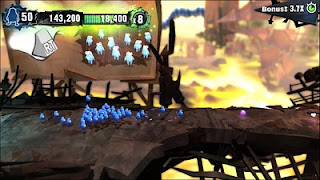
"Swarm" is just such a game. It's extremely light on story: You play, unsurprisingly, as a swarm of 50 "swarmites," who've been deposited on a rather hostile planet with their "mother" who spits them out at the beginning of each level and sucks the survivors back in at the end once they've traversed the area and gathered the energy necessary for her to grow.
While you can't control any of the swarmites individually, unless you find yourself left with only one, you can give the swarm commands for directional movement, jumping, clustering and spreading out, which they'll basically follow to the best of their ability. This means that they'll do what you want them to do for the most part, but are easily distracted by shiny and/or deadly things and don't have much of a self-preservation instinct to speak of; such that telling them all to cluster together and run into a spinning saw blade will result in them all being cut to ribbons. :)
In an interesting mechanical twist, you can combine the basic movement commands to achieve interesting results, such as clustering the swarm to charge their collective energy then spreading it while moving for a quick speed boost, or jumping while clustered to create a sort-of swarmite totem pole for reaching things out of normal jumping range.
The really interesting and borderline sadistic part of the game is how disposable the swarmites are. Only one need reach the end of a level to complete it and there are many spawn points along the way in each level to replenish the swarm up to its maximum of 50, so the game outright encourages you to use them recklessly; going so far as to provide a combo system that can be extended by periodically sacrificing the occasional swarmite in a variety of gruesome ways.

The idea of a game that not only embraces but encourages the wholesale murder of its protagonists is pretty unique. There have certainly been games based around the idea of disposable creatures in the past. "Lemmings" springs to mind, but the gusto and ferocity with which it's done in "Swarm" kinda raises the bar. There were several times while playing the game when I found myself gasping audibly and literally apologizing to the screen for the horrors I'd unwittingly or intentionally visited upon the poor little buggers running desperately across it.
The mixture of joy and remorse the game managed to invoke in me is a testament to just how cool and well-implemented a premise it has. I'm only a few levels into the game, so don't take this as a "review" of it as a whole, but I just can't help singing its praises based on what I've experienced so far. At $15, I feel like I've already gotten my money's worth out of it after just a few hours and would encourage all of you to at least check out the demo on your system of choice.
Don't get me wrong. I completely understand people being upset about paying $60 for a game experience that only lasts five hours, but that's a topic for another post. I'm talking about the idea of it being completely acceptable and often-times preferable for a game to be more of a casual experience; something I can fiddle around with for 20 minutes at a time and get a sense of satisfaction that scales based on the effort I put into it.

"Swarm" is just such a game. It's extremely light on story: You play, unsurprisingly, as a swarm of 50 "swarmites," who've been deposited on a rather hostile planet with their "mother" who spits them out at the beginning of each level and sucks the survivors back in at the end once they've traversed the area and gathered the energy necessary for her to grow.
While you can't control any of the swarmites individually, unless you find yourself left with only one, you can give the swarm commands for directional movement, jumping, clustering and spreading out, which they'll basically follow to the best of their ability. This means that they'll do what you want them to do for the most part, but are easily distracted by shiny and/or deadly things and don't have much of a self-preservation instinct to speak of; such that telling them all to cluster together and run into a spinning saw blade will result in them all being cut to ribbons. :)
In an interesting mechanical twist, you can combine the basic movement commands to achieve interesting results, such as clustering the swarm to charge their collective energy then spreading it while moving for a quick speed boost, or jumping while clustered to create a sort-of swarmite totem pole for reaching things out of normal jumping range.
The really interesting and borderline sadistic part of the game is how disposable the swarmites are. Only one need reach the end of a level to complete it and there are many spawn points along the way in each level to replenish the swarm up to its maximum of 50, so the game outright encourages you to use them recklessly; going so far as to provide a combo system that can be extended by periodically sacrificing the occasional swarmite in a variety of gruesome ways.

The idea of a game that not only embraces but encourages the wholesale murder of its protagonists is pretty unique. There have certainly been games based around the idea of disposable creatures in the past. "Lemmings" springs to mind, but the gusto and ferocity with which it's done in "Swarm" kinda raises the bar. There were several times while playing the game when I found myself gasping audibly and literally apologizing to the screen for the horrors I'd unwittingly or intentionally visited upon the poor little buggers running desperately across it.
The mixture of joy and remorse the game managed to invoke in me is a testament to just how cool and well-implemented a premise it has. I'm only a few levels into the game, so don't take this as a "review" of it as a whole, but I just can't help singing its praises based on what I've experienced so far. At $15, I feel like I've already gotten my money's worth out of it after just a few hours and would encourage all of you to at least check out the demo on your system of choice.
Thursday, March 17, 2011
It's Not What You Play but Who You Play it with...
I've been playing a lot of multiplayer games lately. From "Battlefield: Bad Company 2" to "Worms: Reloaded" to "Killzone 3" to "Tetris" - Yeah, there's multiplayer in that now too. :)
The thing I've found myself acutely reminded of as a result is how much the people you're playing with dictate the sort of experience you're going to have and how it's often necessary to either adjust your expectations and play style or seek out a different group of people to play with to attain and prolong positive experiences no matter how well crafted the games themselves might be.
This really hit home for me the other day while playing the "Warzone" mode in "Killzone 3." For those unfamiliar with it, "Warzone" consists of a random set of game modes that flow into one another during an overall match between two teams representing the game's two factions. You might for example play a team-deathmatch style mode for five minutes where the only objective is to kill more members of the opposing team than they kill of yours. As soon as that mode ends, you might be tasked with defending a spot on the map for five minutes while the enemy team tries to plant explosives there, or assassinating a particular player on the other team while they try to protect them for a time.
It's a very fluid style of play as you're never sure what the next objective is going to be and spots on the various maps that are ideal for particular scenarios are completely worthless in others. Good players are constantly assessing the in-game situation and adjusting their play accordingly, but when that doesn't happen, your team is likely to get steamrolled.
Case in point, I played two "Warzone" matches the other day. In the first, my team could not have been more coordinated. People were moving in groups, playing their respective roles and utterly dominating the other team as a result. The next match I played was the polar opposite, with players lone-wolfing, going to parts of the map that weren't relevant to the objectives and using the game's voice chat to insult each other rather than offering any useful information or feedback.
The difference in the two rounds was so striking that it literally gave me pause as I pondered how and why the pendulum could swing so radically from match to match, but the answers came to me pretty easily given a little consideration.
The simple answer is that who you're playing with matters much more than what you're playing. Do they understand the mechanics of the game? Do they know the levels/environments the game is being played in? Are they high on meth? Do they understand basic principles of strategy and tactics? Are they assholes? Are they easy or difficult to communicate and coordinate with and do you have a relationship or rapport with them outside of the game?
When you stop and think about it, there are a lot of great reasons why random groups of people playing objective-based games together online shouldn't ever succeed, but clearly they do at least 50% of the time because one team always wins. Of course, that discounts the possibility of clan play, which is made very easy in modern games like "Killzone 3," but I'm talking about encounters where both teams are comprised of people randomly grouped together by an automated matchmaking system. In those cases, something happens that makes one team "better" than the other, and given how carefully balanced most multiplayer games are these days, it would seem to come down to the individual players on each side and how they work with or against each other.
As someone who typically plays a support class in these sorts of games; the guy who stands behind the guy up front and helps them succeed by keeping them alive or providing additional fire on their targets, I like to think that a big part of all this comes down to what I like to call "difference makers" - people who play in a way that's more concerned with benefiting their team than their own personal score. It's tempting to ascribe some sort of subconscious, psychological significance to it; perhaps assuming that the way people play games online is a reflection of the way they are in real life and that there's somehow a general lack of people willing to put the good of those around them ahead of their own personal gain such that when a few people who are willing to do that show up on one team or another it's enough to turn the tide. That could well be true but I've found it's not that cut and dry. Quite often, people's online personas and actions are very different from their "real life" behaviors or vary based on mood, so I don't think it's something that cam be simply generalized, but it seems clear that, regardless of the catalyst, a significant number of players on a given team choosing to play as a team makes a difference.
I guess the bottom line to all this is that it's made me appreciate even more the value of playing games with friends. Simply sharing those experiences with them make them better in very meaningful and measurable ways. There's another level of synergy that groups of friends have that translates very well into the realm of most game worlds. As long as the game doesn't do anything to get in the way of it, it just happens.
Perhaps that too is the difference between a great gaming clan and those based on random collections of internet strangers; that personal connection that makes people try a little bit harder or give a bit more thought to their actions. I think it's much the same as what makes a great sports team or professional organization.
Not exactly revolutionary thinking I know, but something that I think is worth considering and remembering from time to time. If nothing else, it makes it a lot easier to tolerate bad random groups and a lot easier to appreciate it when things go right. And if you do find yourself in one of those bad groups, pro tip, use the opportunity to try out new and unorthodox in-game strategies. You might end up making some lemonade.
The thing I've found myself acutely reminded of as a result is how much the people you're playing with dictate the sort of experience you're going to have and how it's often necessary to either adjust your expectations and play style or seek out a different group of people to play with to attain and prolong positive experiences no matter how well crafted the games themselves might be.
This really hit home for me the other day while playing the "Warzone" mode in "Killzone 3." For those unfamiliar with it, "Warzone" consists of a random set of game modes that flow into one another during an overall match between two teams representing the game's two factions. You might for example play a team-deathmatch style mode for five minutes where the only objective is to kill more members of the opposing team than they kill of yours. As soon as that mode ends, you might be tasked with defending a spot on the map for five minutes while the enemy team tries to plant explosives there, or assassinating a particular player on the other team while they try to protect them for a time.
It's a very fluid style of play as you're never sure what the next objective is going to be and spots on the various maps that are ideal for particular scenarios are completely worthless in others. Good players are constantly assessing the in-game situation and adjusting their play accordingly, but when that doesn't happen, your team is likely to get steamrolled.
Case in point, I played two "Warzone" matches the other day. In the first, my team could not have been more coordinated. People were moving in groups, playing their respective roles and utterly dominating the other team as a result. The next match I played was the polar opposite, with players lone-wolfing, going to parts of the map that weren't relevant to the objectives and using the game's voice chat to insult each other rather than offering any useful information or feedback.
The difference in the two rounds was so striking that it literally gave me pause as I pondered how and why the pendulum could swing so radically from match to match, but the answers came to me pretty easily given a little consideration.
The simple answer is that who you're playing with matters much more than what you're playing. Do they understand the mechanics of the game? Do they know the levels/environments the game is being played in? Are they high on meth? Do they understand basic principles of strategy and tactics? Are they assholes? Are they easy or difficult to communicate and coordinate with and do you have a relationship or rapport with them outside of the game?
When you stop and think about it, there are a lot of great reasons why random groups of people playing objective-based games together online shouldn't ever succeed, but clearly they do at least 50% of the time because one team always wins. Of course, that discounts the possibility of clan play, which is made very easy in modern games like "Killzone 3," but I'm talking about encounters where both teams are comprised of people randomly grouped together by an automated matchmaking system. In those cases, something happens that makes one team "better" than the other, and given how carefully balanced most multiplayer games are these days, it would seem to come down to the individual players on each side and how they work with or against each other.
As someone who typically plays a support class in these sorts of games; the guy who stands behind the guy up front and helps them succeed by keeping them alive or providing additional fire on their targets, I like to think that a big part of all this comes down to what I like to call "difference makers" - people who play in a way that's more concerned with benefiting their team than their own personal score. It's tempting to ascribe some sort of subconscious, psychological significance to it; perhaps assuming that the way people play games online is a reflection of the way they are in real life and that there's somehow a general lack of people willing to put the good of those around them ahead of their own personal gain such that when a few people who are willing to do that show up on one team or another it's enough to turn the tide. That could well be true but I've found it's not that cut and dry. Quite often, people's online personas and actions are very different from their "real life" behaviors or vary based on mood, so I don't think it's something that cam be simply generalized, but it seems clear that, regardless of the catalyst, a significant number of players on a given team choosing to play as a team makes a difference.
I guess the bottom line to all this is that it's made me appreciate even more the value of playing games with friends. Simply sharing those experiences with them make them better in very meaningful and measurable ways. There's another level of synergy that groups of friends have that translates very well into the realm of most game worlds. As long as the game doesn't do anything to get in the way of it, it just happens.
Perhaps that too is the difference between a great gaming clan and those based on random collections of internet strangers; that personal connection that makes people try a little bit harder or give a bit more thought to their actions. I think it's much the same as what makes a great sports team or professional organization.
Not exactly revolutionary thinking I know, but something that I think is worth considering and remembering from time to time. If nothing else, it makes it a lot easier to tolerate bad random groups and a lot easier to appreciate it when things go right. And if you do find yourself in one of those bad groups, pro tip, use the opportunity to try out new and unorthodox in-game strategies. You might end up making some lemonade.
Subscribe to:
Posts (Atom)